February 24, 2026
Language Versions: Challenges and strategies for multilingual production

Tünde Máté
Operations Manager
All of Mindclash Games’ 10 core titles so far have been published in at least two languages (and some even in eleven!). As a publisher working extensively with multilingual board game production, we have longstanding partnerships with our publishing partners for certain languages, while others are relatively new and are only now being explored.
The number of languages and the method of making them available to players have varied significantly across our games, and the reasons are quite interesting. Multilingual board game production is never a one-size-fits-all process; each project comes with its own logistical, financial, and creative considerations. Let’s dive into the challenges of translating board games first, then take a look at some examples of making it work.
The Biggest Challenges in Multilingual Board Game Production
Designing a board game in one language is a challenge in itself – but making that game available in multiple languages requires strategic decisions from day one of the design process.
Language dependency in components
One of the core challenges of translating board games is language dependency in physical components. While there are some components in board games that simply cannot be language-independent (like the box and the rulebook), most components should be carefully assessed with this factor in mind.
Is it possible to fully iconize what that board or card has to say? Is the iconography clear enough to stand on its own? Do those cards or punchboard tiles really need unique titles?
These are critical questions in multilingual board game production: the fewer components that have text that needs to be translated, the smoother the process will be in the end. At Mindclash Games, we try to use iconography instead of text whenever possible, precisely to reduce the complexity of future language versions.
Layout constraints and file preparation
Another major aspect of localization is graphic design flexibility.
As soon as a graphic designer starts working on a board game, they should have the possibility of foreign languages in mind. For example, German words tend to be much longer than English words, thus the graphic designer has to design certain graphic elements in a way that allows them to be modified according to the length of the translated text. It’s not uncommon for translated text to require 20-30% more space than the original English version.
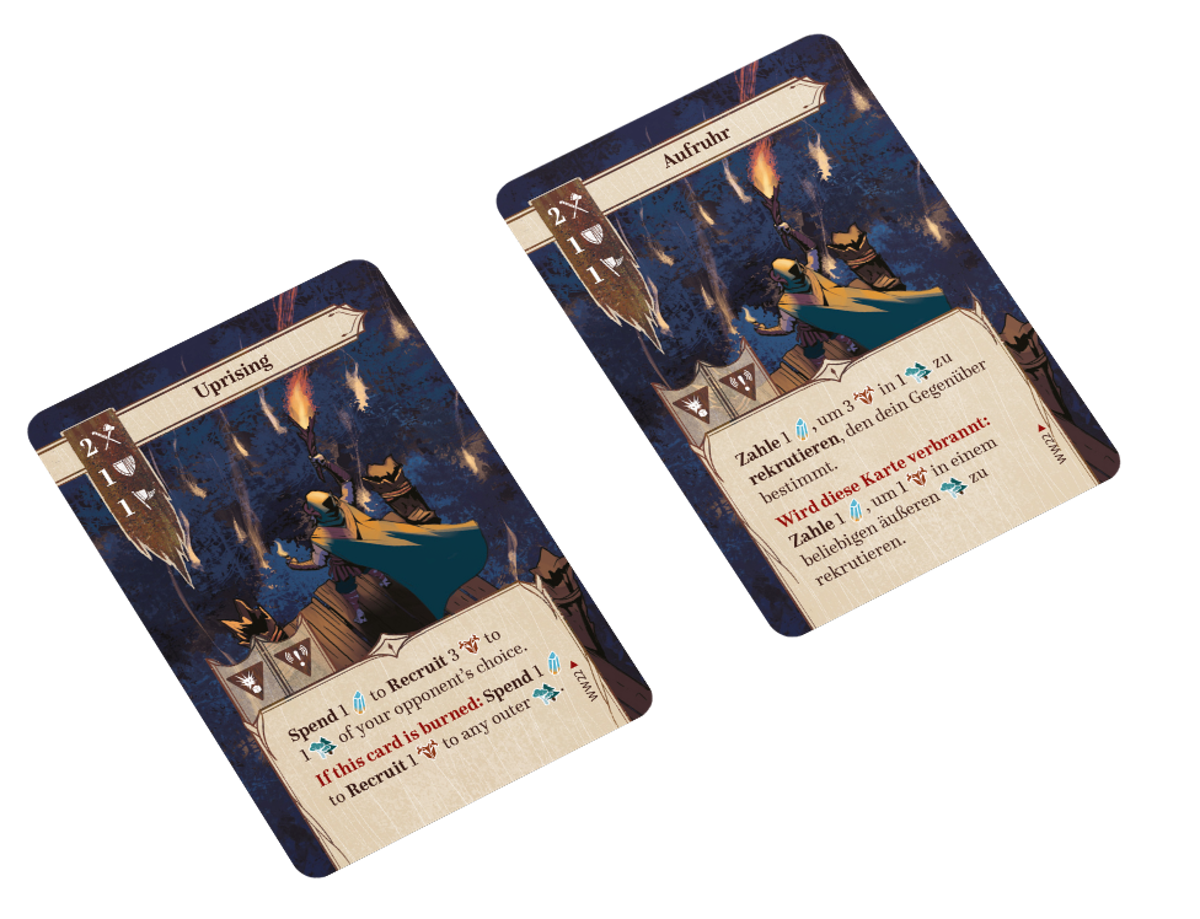
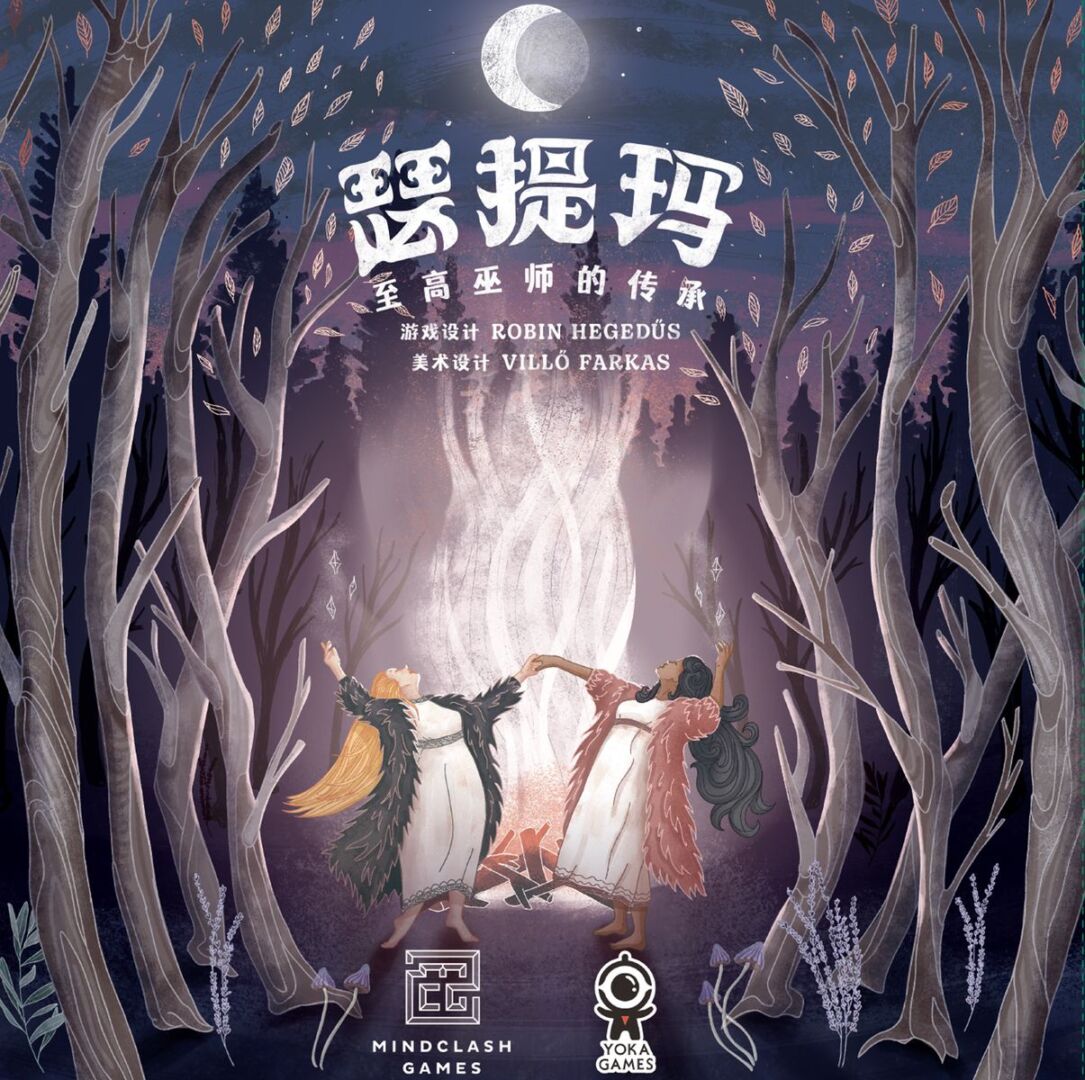
While creating the original English files, it is also very important to keep all text editable. Even if we use names in a game that should not be translated, language partners that use non-Latin alphabets still need to be able to edit those names. Proper file preparation is a crucial but often underestimated part of multilingual board game production.
Timeline management
A big question when printing a new game is how many language versions to include in the first print.
On the one hand, printing more languages immediately makes the game accessible to a broader audience and can increase overall success. On the other hand, each additional language adds complexity and risk to the production timeline. The more language partners join a print run, the more time-consuming the pre-press check becomes — the process during which the manufacturer reviews uploaded print files and the publisher implements corrections.
The more partners involved, the greater the risk that one of them misses a deadline and delays the entire print process. Manufacturers can only start printing once all files are submitted and approved, and one or two weeks of delay from one partner in file submission can easily turn into a month of delay in overall production.
For these reasons exactly, sometimes we decide to only print a game in English in the first print run. This reduces both the logistical risks and the timeline impact of translation, shortening the overall production schedule by one to three months.
Print Production Complexity
The number of language versions has a direct impact on the complexity of multilingual board game production.
Our deluxe, crowdfunding-exclusive games are usually only printed in 3 or 4 languages to keep the balance between smooth production and catering to backers. Retail titles, however, are often printed in print runs of 5-10 languages; coordinating file submission, file checks and digital proof approvals is a great challenge not only for us, but also for our manufacturing partner.
Different partners requesting different product combinations can further complicate matters. For example, if three partners want to print the base game, but each wants only 500 copies of a different expansion, production becomes difficult because the MOQ for a product is usually 1500 units per print run.
This needs to be coordinated on our side, we have to collect printing needs in advance and try to fulfill the MOQ for all products. Freight shipping also needs to be planned carefully, as our manufacturing partner can only warehouse games for so long after they are ready, and all language partners need to take care of their own shipments.
Strategic Planning for Language Editions – Case Studies
Let’s look at some real examples of multilingual board game production at Mindclash Games. Certain factors – such as partners opting out due to projected market demand or MOQ limitations – are not detailed here for the sake of brevity.
When full localization is not possible
Perseverance: Castaway Chronicles was an ambitious project from the start – two massive boxes including four episodic standalone games.
Each episode includes important text elements on punchboard tiles, the main board and cards besides the rulebooks and player aids, so fully localizing the product would have been a big undertaking, and it would have significantly increased manufacturing costs, as a plate change fee applies to each translated component.
We ultimately determined that language packs were the most efficient solution. Only the rulebooks and player aids were translated to French, German and Spanish and offered in a separate package to backers. This way, the game is fully playable even if the player does not speak English – the rulebooks use the English location and officer names that are present on the main board and punchboard tiles. Cards only have text in their titles, which don’t necessarily have to be understood to play the game.
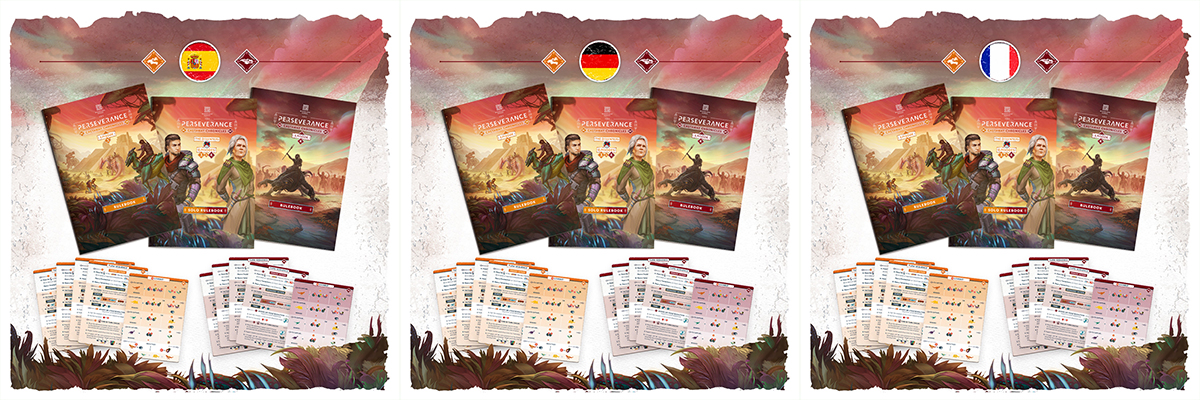
Language packs are sometimes the most practical compromise in multilingual board game production, allowing accessibility without multiplying manufacturing complexity.
When localization becomes a bit too much to handle
As we were planning the Trickerion Anniversary Edition campaign for the game’s (and our company’s) 10th anniversary, we wanted to make it as big as possible for everyone who loves Trickerion and also those that would like to try it for the first time. In order to make the new expansion and the Anniversary Edition accessible to as many people as possible, we offered it to all of our language partners.
Luckily, they were enthusiastic, and the Trickerion Anniversary print run ended up including 10 different languages: English, French, German, Spanish, Czech, Polish, Chinese, Brazilian Portuguese, Russian and Japanese. We were so happy about so many partners joining us, but this was something we have never done before: printing a product for the first time ever in so many language versions! In the end, working together with so many partners proved to be an extremely complicated process and it did cause some delays and a lot of stress in production for all parties.
Although we are proud of the result, this scope of simultaneous localization is not something we would repeat for a similarly complex project.
The optimal localization strategy for exclusive games
Voidfall represents what we consider a sustainable model for multilingual board game production in deluxe projects. The game is extremely complicated and text-heavy (more than 50,000 words to be translated!), so we knew from the start that we needed to offer language versions to make it accessible to more players that are not native English speakers.
What we did with Voidfall is more or less the exact strategy that we have used for our crowdfunding campaigns ever since: offer the exclusive deluxe edition in the 3 languages that are most sought after (English, French and German), and only print any other language versions in a second, international retail print run shortly after the first one. This allows us to keep strict and relatively short deadlines for the first print run, but at the same time, customers looking for a different language should be able to purchase the retail version of the game on their local market shortly after the campaign is fulfilled.
The optimal localization strategy for “straight to retail” games
Emberheart was our first Mindclash Play title where we experimented with making the first print run international. Because the game contains relatively little text, the challenges of translating board games were more manageable.
We successfully produced seven languages in the first print run. Our partners were all absolutely professional, and the smaller amount of material that had to be translated also helped to avoid delays in production.
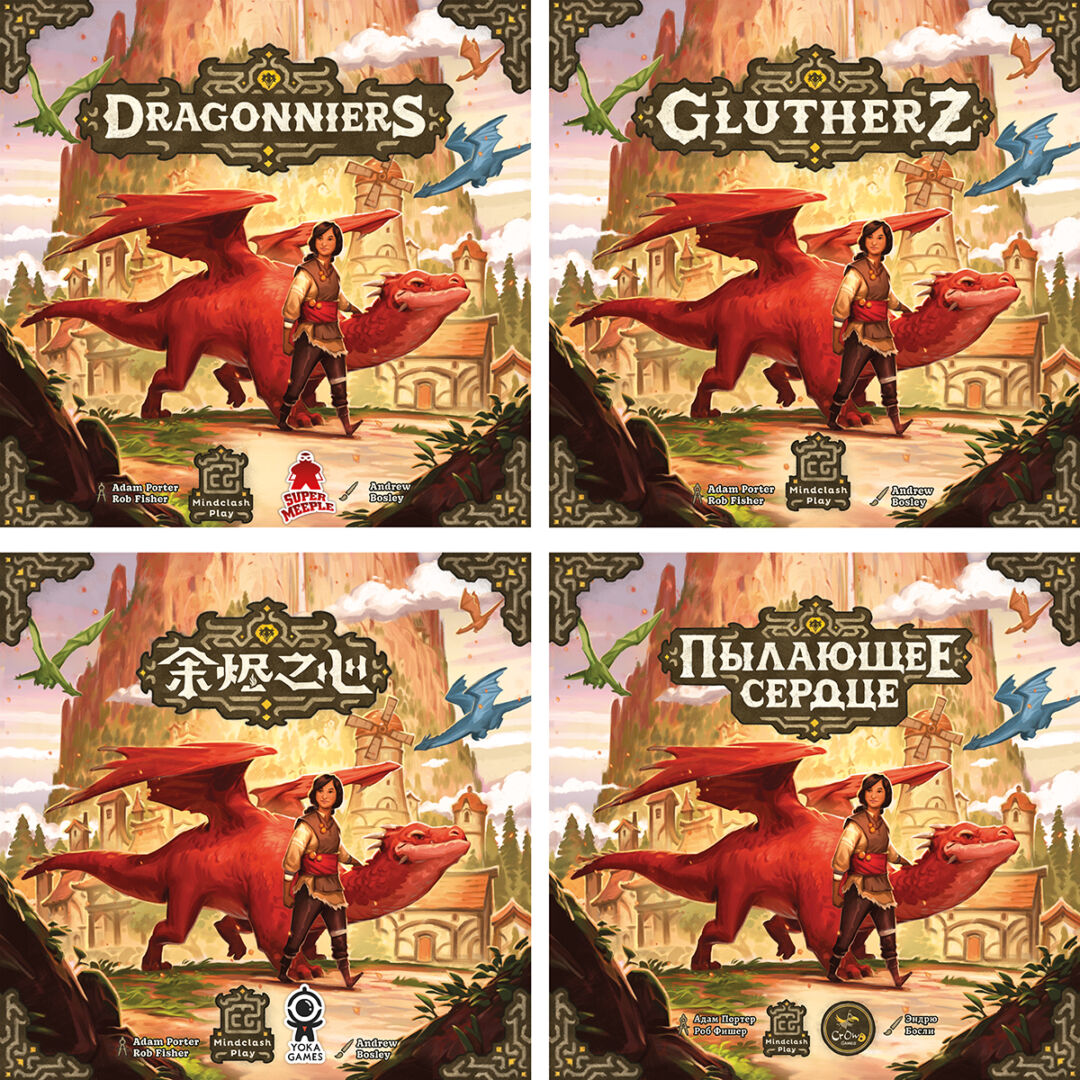
In the future, whenever timelines allow, we aim to release Mindclash Play titles in multiple languages from the start.
Conclusion
Multilingual board game production is far more than a translation – it is a strategic, logistical, and creative challenge that influences design decisions from the very first prototype to the final freight shipment. As we’ve seen, the challenges of translating board games range from layout constraints and text expansion to MOQ coordination and production timelines. There is no ultimate universal solution: each title requires a tailored approach based on its complexity, target markets, and production scope.
By planning ahead, designing with language independence in mind, and choosing the right localization strategy for each project, publishers can balance accessibility with operational efficiency. In the end, successful multilingual board game production is not about maximizing the number of language versions, but about making thoughtful, sustainable choices that serve both players and long-term publishing strategy.