January 28, 2026
Illustration in Board Games: The Power of Visual Storytelling

Frigyes Schőberl
Creative & Project Manager
See how we use illustration to connect gameplay and theme, turning abstract systems into stories that players can easily understand and enjoy.
Board games are art. They provide an experience to the player, much like a piece of music, a painting, or a novel. For this reason, board games are also a form of self-expression and an invitation to experience the messages and emotions of designers and artists alike. This is something I have come to realize over the ten years I have spent at Mindclash Games, and now, as a Creative Producer, my goal is to ensure that those who play our games don’t just receive a good gameplay experience, but truly become part of the game’s world, story, and events.
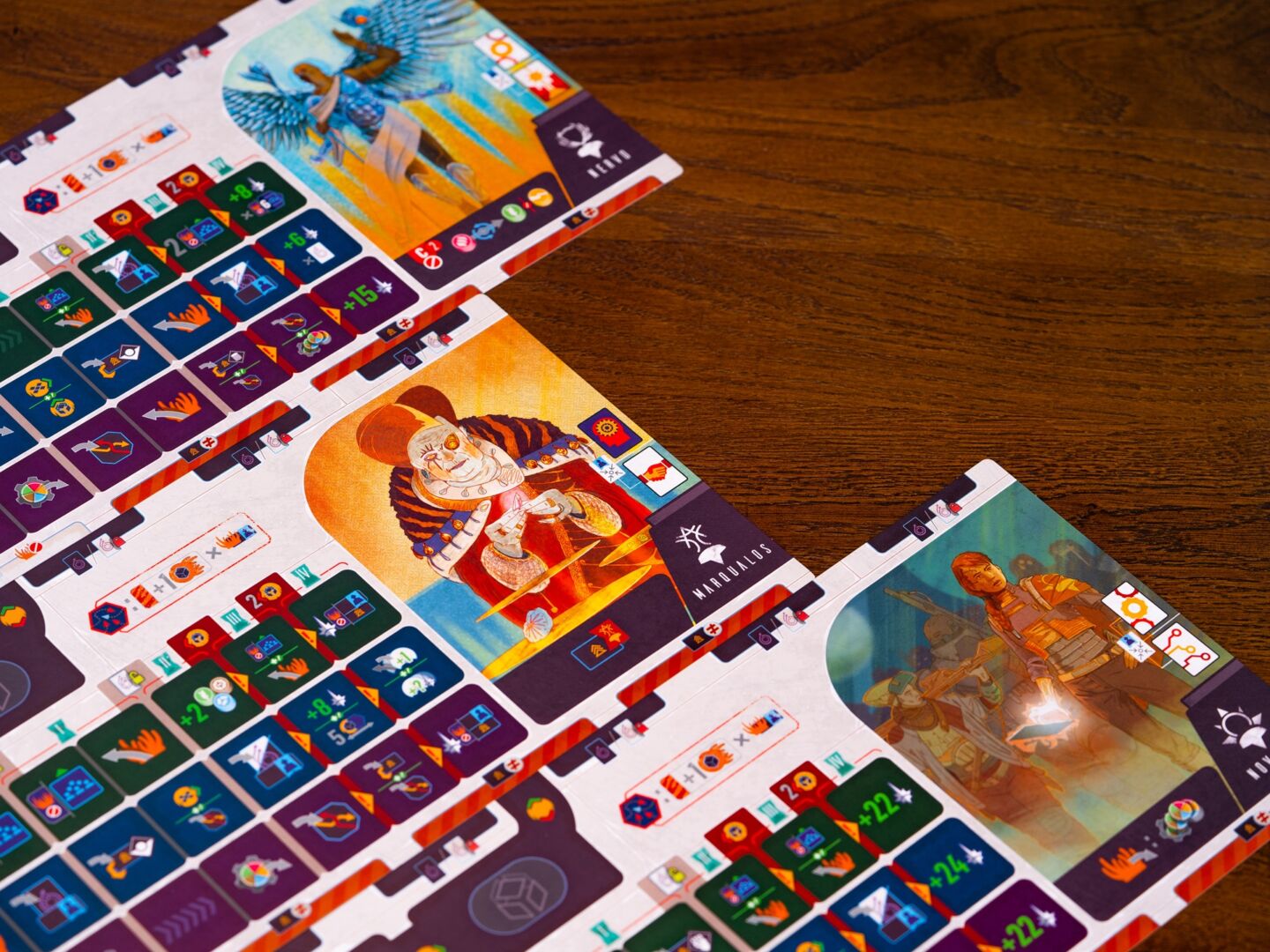
In strategic board games, where the story does not unfold through scripted text, meaning must come from the interaction between mechanics, theme, and visual design. When art depicts what game actions represent within the world, mechanics become events, players become participants in a story, and learning becomes more intuitive. This is how visual storytelling transforms abstract systems into lived experiences, as seen in our games like Trickerion, Ironwood, Emberheart, and Voidfall.
From Abstract Systems to Meaningful Actions
To achieve this level of immersion, I believe three things are essential: the gameplay must be interesting, the theme must be engaging, and the two must merge intuitively. The functionality and playability of board games are built upon systems of abstract mechanics and rules. The theme helps to put this abstraction into context, making the system easier to understand and interpret. It is the theme that gives meaning – within the context of the game world – to both the mechanics and the players’ actions.
In other words, whatever we do and whatever happens in a board game on a mechanical level, there is always a story somewhere within the game’s own universe. In a thematic board game, you don’t gain a resource cube – you harvest crops. You don’t simply draw a card – you discover a forgotten technology of an ancient civilization. And you don’t just move your marker on a track – you gain influence over the people of an empire. Losing a unit is not just a numerical setback, but a real defeat, a true sacrifice. This is why we at Mindclash Games continuously strive to ensure that every mechanic and every action in our games also makes sense thematically.
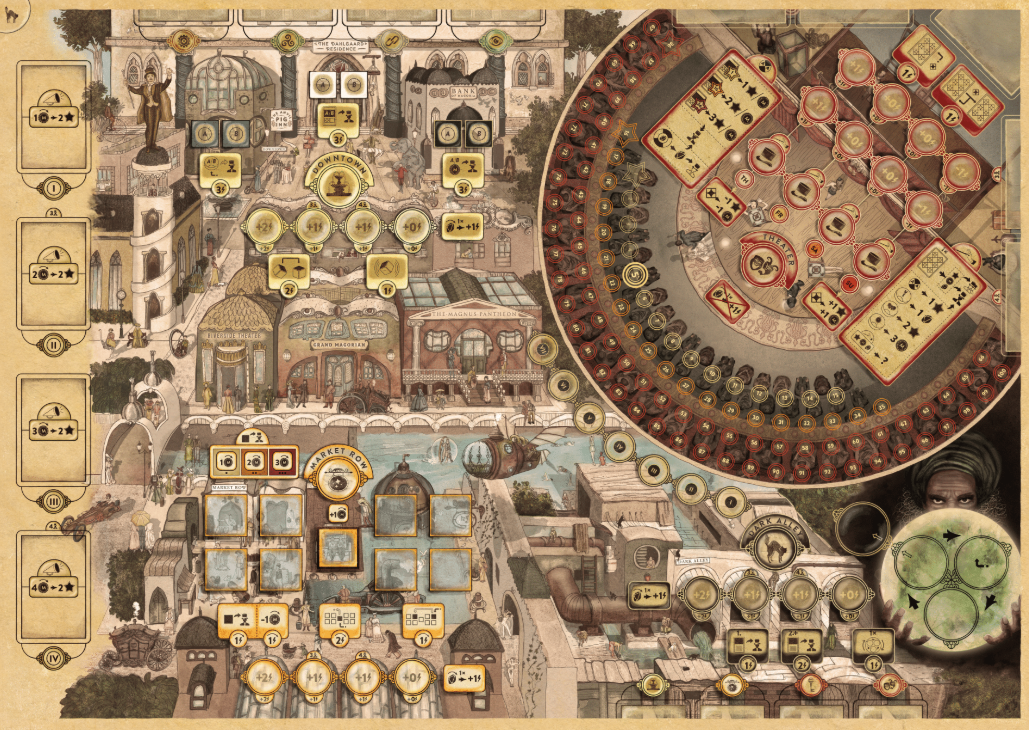
Once the theme has successfully relieved the player’s mind from the abstraction of the underlying system and the mechanics have been transformed into stories, the path toward immersion becomes much smoother. Proper thematic integration, along with a thematically implemented user interface and iconography, reinforces this further by creating a bridge between the system and the player. One that enhances usability and leaves even more room for seamless immersion.
Why Illustration Is the Strongest Storytelling Tool
However, to achieve full immersion, it is not enough for a theme to be engaging and intuitively integrated into an interesting gameplay. Even if thematic mechanics are capable of telling stories, those stories must also be presented. Because board games are a physical form of self-expression, they tell stories through visual tools: game components, user interface, icons, miniatures, and illustrations.
User interface and iconography are primarily functional. They must be clear, readable, and consistent, often sacrificing expressiveness for usability. Miniatures (although they can be beautifully crafted and highly detailed) are limited in their ability to convey anything beyond the subject of the miniature itself. Game components reinforce the theme through material and form, but rarely tell specific stories. Each of these has its own role, possibilities, and limitations when it comes to conveying theme, but among them all, illustrations are the most effective storytelling tool.
When it comes to board games, I believe it is important that illustrations not only create atmosphere but also depict in-game situations, conditions, and events, framing the players’ actions within a broader story. In other words, what happens in the image should also make sense when translated into gameplay.
Let me give you an example.
When Mechanics Become Stories, Examples from Our Games
IRONWOOD
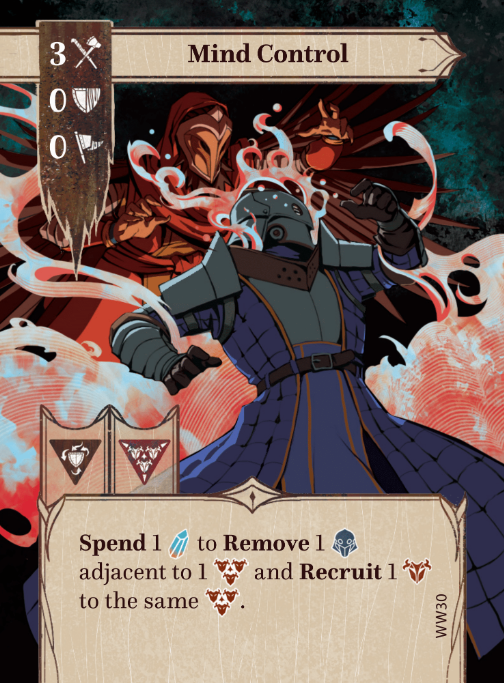
In Ironwood, one of the action cards of the Woodwalker faction allows the player to remove an Ironclad Fighter from one of their opponent’s Warbands and add a Woodwalker Fighter to one of their own. From a purely mechanical perspective, this is a simple exchange: one unit is removed, another is added. On its own, this action is functional but emotionally neutral. There is no story. Within the world of Ironwood, however, we interpret this mechanical action as a Woodwalker sorcerer performing a Mind Control spell on an Ironclad soldier, turning them to their own side. With a beautiful illustration depicting this very moment and a straightforward title that reinforces this interpretation, the result is a clear narrative concept, a story.
By framing the mechanic as a specific event within the game world, the action becomes far more engaging. Players no longer feel like they are simply manipulating pieces on a board; they feel like they are influencing characters and events within a living setting. The act of removing an enemy unit and gaining one of your own becomes a story rather than a technical step. This makes it much easier for players to immerse themselves in the game and to remember the moment long after the session ends.
This approach highlights an important reality of board game design: due to their nature, board games have limited tools for explicit storytelling. Of course, there are many narrative-driven games that rely on branching storylines, scripted events, and extensive text. These games excel at delivering structured narratives. However, strategic games, such as those that define the Mindclash Games portfolio, operate differently. Their focus is on player-driven decision-making and replayability. As a result, they cannot rely on linear storytelling or predefined narrative arcs.
Instead, these games tell their stories through systems. They rely on thematically integrated mechanics, carefully chosen terminology, and evocative illustrations to suggest narrative meaning. The story does not unfold through paragraphs of text, but through the interaction between players and the game’s systems. In this context, illustrations play a critical role. They act as windows into the world that frame each action within a larger fictional context.
EMBERHEART
Let me give you another, even simpler example.
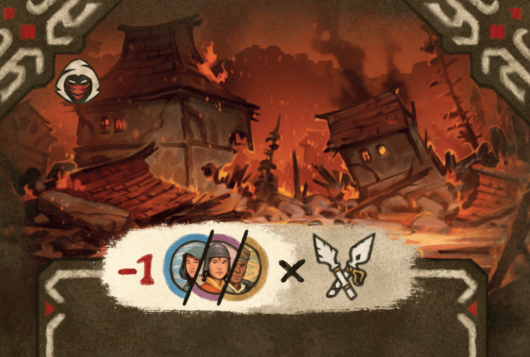
In Emberheart, at the end of each round, the game effectively “taxes” the players: under certain conditions, they must pay a specific type and amount of Hirelings. Within the world of the game, this is explained as the village (where most of the game takes place) being periodically ravaged by ruthless poachers. These events are represented by Raid cards, and the illustration on them depicts the damage they cause. The Hirelings paid as “tax” are, according to the narrative, assigned to repair and restore this destruction.
That single image adds a simple yet profound layer of meaning to what happens when the player is required to “pay workers”. It does not explain everything, nor does it need to. Instead, it leaves room for the player’s imagination to fill in the gaps. And it is precisely this subtlety that elevates immersion to a higher level.
Illustrations that accurately depict how a game functions within its world do more than enhance immersion and storytelling – they also support understanding and learning. For example, it often happens to me that when I play a game for the first time and finally have a general grasp of the rules, I don’t immediately start analyzing my starting options or planning for an optimal strategy. Instead, I prefer to discover the game by playing it.
When a game asks me to choose a character or faction at the beginning, I always look to the illustrations for guidance. If a character’s depiction communicates a feeling that aligns with its intended strategy, mechanics, and abilities, choosing a character that fits my playstyle becomes far more intuitive.
VOIDFALL
A character illustration alone already lays the foundation for the narrative of my in-game actions. In Voidfall, for example, I perceive conquering a sector very differently depending on whether it is done by House Shiveus or House Zenor. The former eradicates the Corruption in an epic, dramatic way while eagerly proclaiming the teachings of their prophecy. The latter, however, exterminates the enemy in a cold, measured, systematic way using their clones – unconcerned with losses, knowing that if necessary, they will simply clone more.
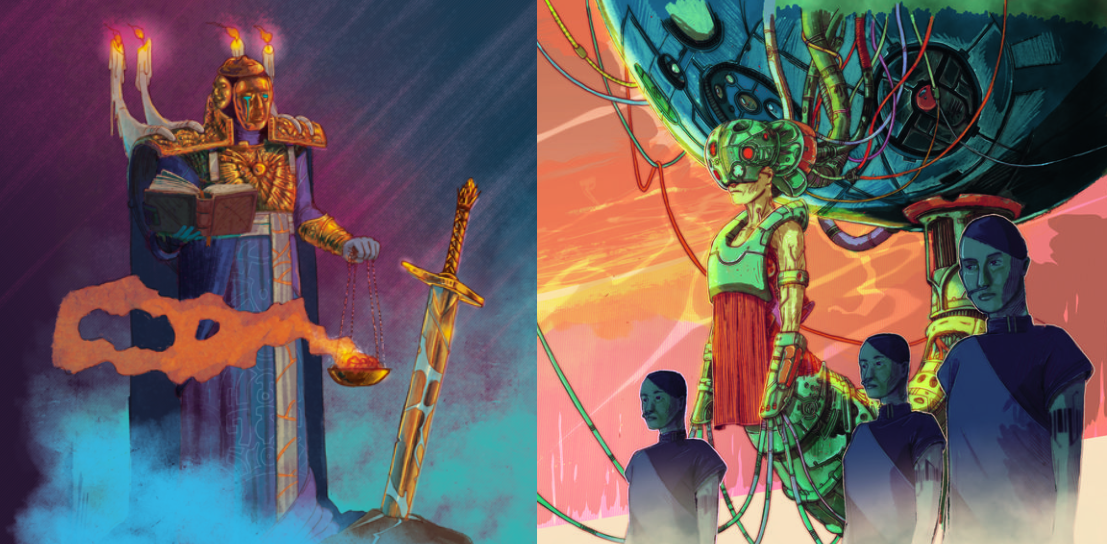
Even though illustrations seem very specific, great board game art does not tell players exactly what to think or feel. They invite players to interpret, to imagine, and to connect. They turn mechanical outcomes into memorable moments. Over time, players may forget the exact wording of a rule, but they will remember that card, that image, that moment when everything changed. These visual memories become an integral part of how players recall and talk about the game.
When Visual Storytelling and Systems Align
As creators at Mindclash Games, our responsibility is not merely to make games that function well, but to create immersive experiences. By aligning illustrations with mechanics, and embedding abstract systems into meaningful visual narratives, we allow players to engage with our games on multiple levels at once. When gameplay, theme, and visual storytelling work together seamlessly, the board game table becomes more than a surface for components – it becomes a stage for stories to unfold. And when players leave the table feeling like they have lived through something, not just played something, that is when a board game truly becomes art.