How was Courtroom created? Follow its journey from a late-night idea to a fully developed investigation game set in 1936 USA.
September 2, 2026
Courtroom – Designer Diary

Robin Hegedűs
Game Designer & Developer
The Game is Afoot
Once you’re drawn into the world of crime and investigation, you find yourself chasing that same thrill again and again. There is something inherently compelling about the genre, combining our fascination with chilling crimes and our desire to discover the clever methods used to catch the culprit.
Tünde and I both share this interest. She is a huge fan of true crime stories, while I devour crime fiction. At Mindclash, Tünde mainly works in production, while I am a game developer, but every now and then, we find ourselves gathered around a game with other members of the team after work. That was exactly what happened in November 2023, when we tried Perspectives, which we had recently brought back from Essen. The game puts a clever twist on the investigation game formula: pieces of evidence are divided among the players, who are not allowed to show them to one another and must instead piece together the full picture from the different perspectives available to them.
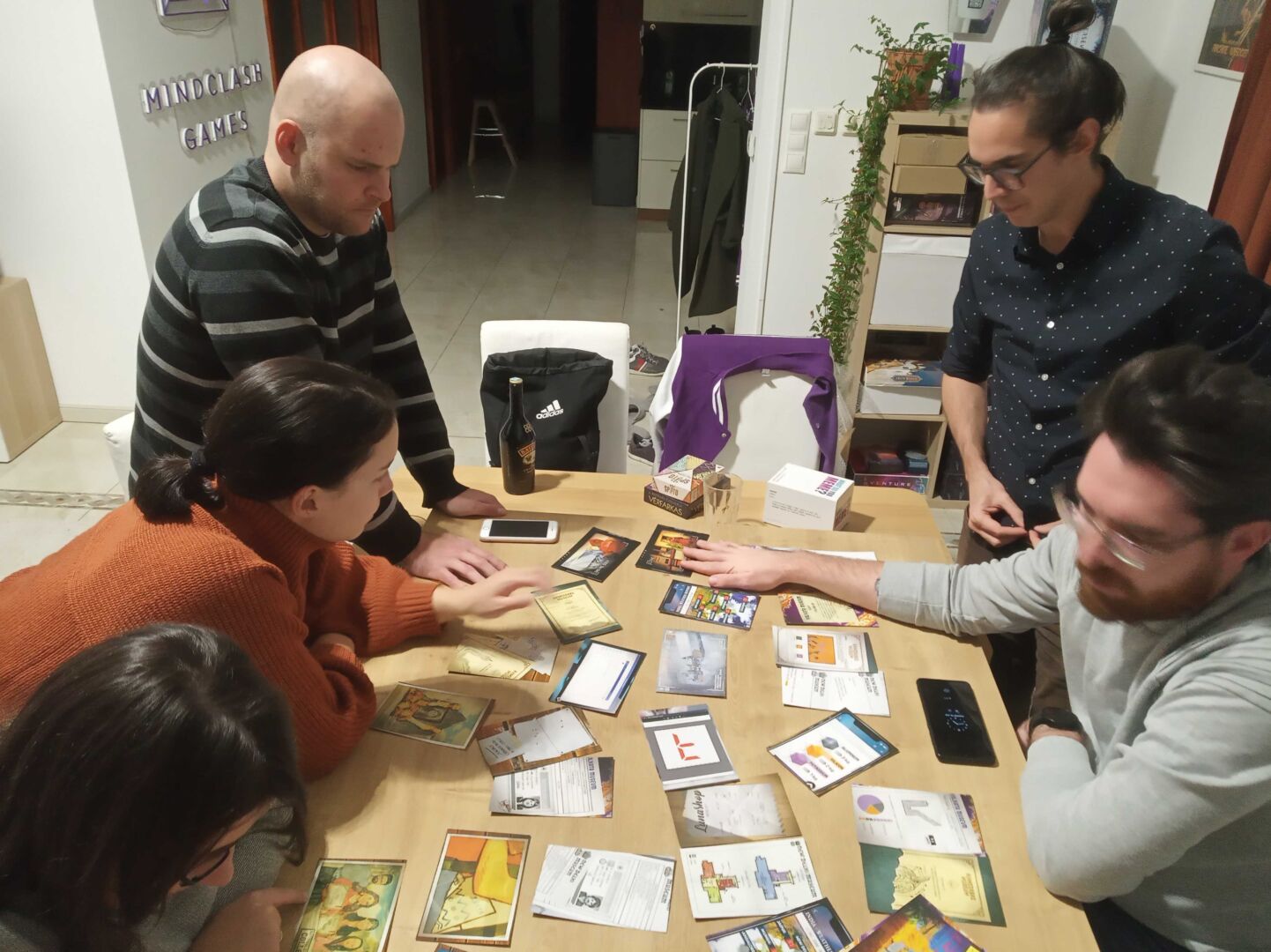
After the game, we were sitting on the terrace of our office, discussing the case we had just solved; this kind of post-game debrief is an essential ritual of detective games. It was then that Tünde casually said the sentence that would eventually become the foundation of Courtroom: “It would be really cool to have a game where you don’t just investigate the case, but also have to present the evidence properly in court.”
I had recently seen Anatomy of a Fall, an incredibly tense and gripping courtroom drama, so the idea immediately struck a chord with me. Within moments, we had completely forgotten about the museum robbery we had just solved, and there, on a chilly November evening, the two of us started brainstorming what a detective game might look like if the events unfolded during the trial itself.
Just a few weeks later, I had already outlined the mechanical framework of the game for Tünde, and before we knew it, our first Case was slowly but steadily filling up with content. It was a peculiar process, because while creating that first court case, we were not entirely sure why we were doing it. The game was clearly outside Mindclash’s usual publishing portfolio, yet it was far too ambitious to be just an internal team-building project. But none of that really mattered. We were simply driven by the strength of the idea and the momentum of weaving that first Case together.
What Is the Truth?
When I start working on the first draft of a game design, I like to ask myself which thematic elements are most important for bringing its world to life. In the courtroom drama genre, Lawyer Up is an unavoidable reference point. It aims to bring the same setting to the table, but approaches it using the mechanical toolkit of tactical games.
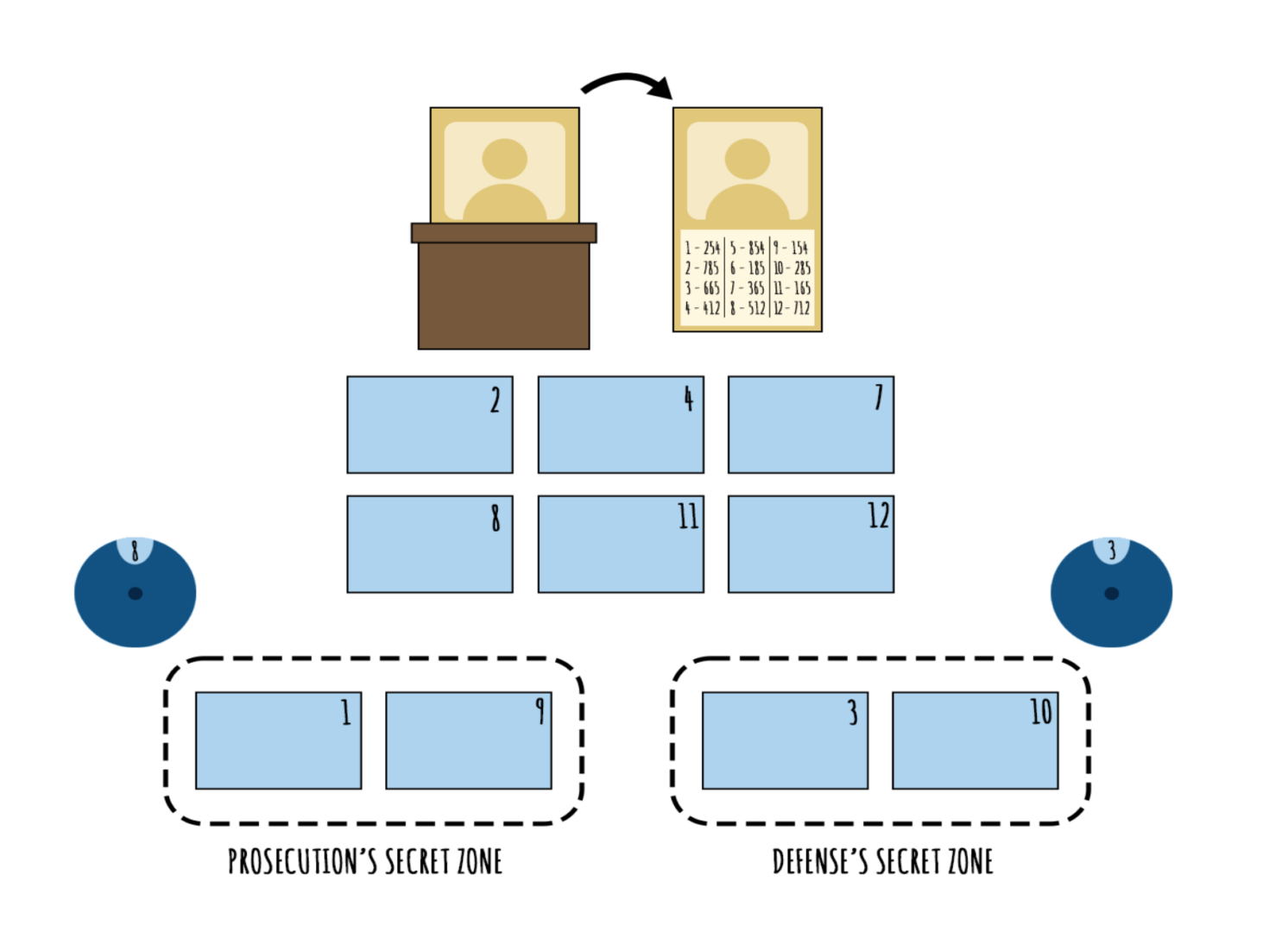
We knew that Courtroom also needed to feature the discovery of evidence, witnesses being questioned by both sides, and the challenge of persuading the jury, but we wanted all of these elements to be much more deeply embedded in a specific story. The game’s main flow had already emerged at the outline stage, consisting of the Discovery Phase, the Testimony Phase, and the Closing Argument Phase, when one of the most important questions in the entire design came up: how can two teams investigate the same case while pursuing two different goals?
This brings us to a question we have heard many times from players after finishing a game: “Okay, but was the suspect actually guilty?”
And this is where one of the most important aspects of the game’s thematic design comes into play, as well as one of the greatest challenges we faced while creating it. Our cases do not have a single, definitive truth. They only have a verdict determined by the court.
That means two groups can play through the exact same trial and reach completely different conclusions. One group might find the defendant guilty, while another might acquit them, and neither verdict is more correct than the other.
When designing the cases, this effectively meant creating two investigations for every single one. We had to figure out how the same pieces of evidence and the same witnesses could simultaneously provide information relevant to both the prosecution’s and the defense’s investigation. Unlike in real court cases, however, the distribution of information here also has to be as fair as possible. Achieving that balance became one of the greatest challenges of designing each Case.
Counsel: You May Proceed!
By the spring of 2024, the first version of Case 1 – Death in the Suburbs was finally complete. In it, Jack Barnham is found dead in his garage, trapped beneath the hood of his car. Was it simply a tragic accident, or did Mrs. Barnham arrange things so that her husband would be permanently out of the picture?
The Mindclash core team gathered around the table, everyone curious to see what Tünde and I had come up with. I was optimistic, but I did not expect the game to come alive with such intensity.
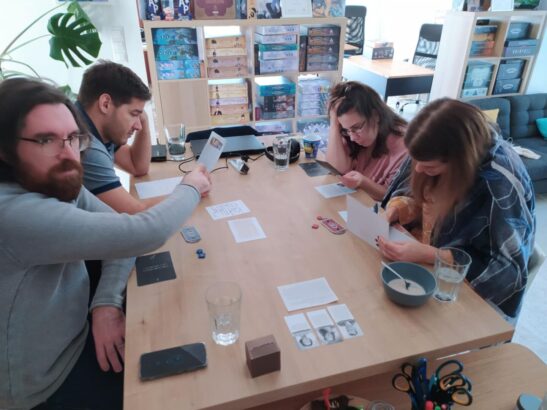
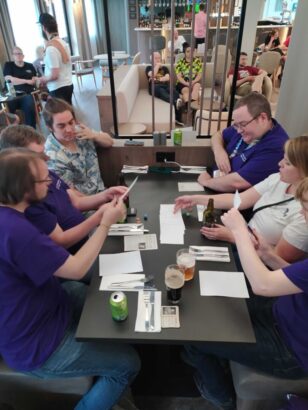
Players who enjoy cooperative games found plenty of opportunities to work together within their teams, while those with a competitive streak were driven by the prospect of defeating the opposing side. Members of both teams whispered excitedly around the table. Their notes multiplied. During the witness testimony phase, they watched the opposing team with growing suspicion. And when the game reached its conclusion, closing arguments were delivered with fantastic passion and conviction.
Everyone left the table with the same impression: the game they had just played was very different from anything we had worked on before, but the experience had been far too good to simply let it disappear.
And ultimately, that is one of the reasons Mindclash Play exists. It gives us the opportunity to publish games created with the same level of care as our larger titles, while making them far more accessible to a broader audience.
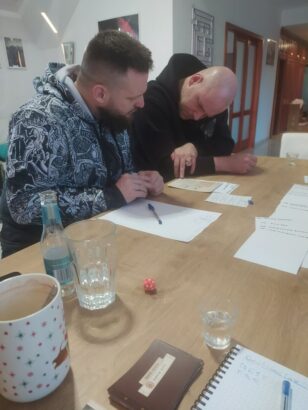
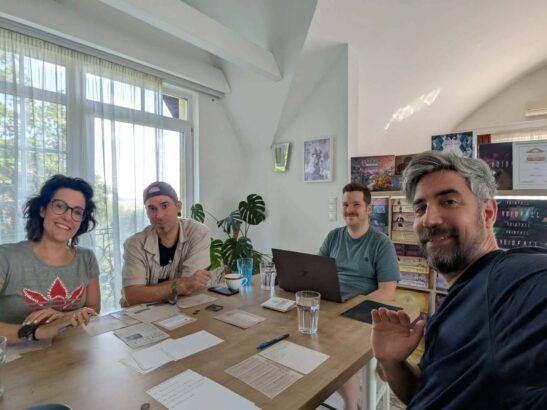
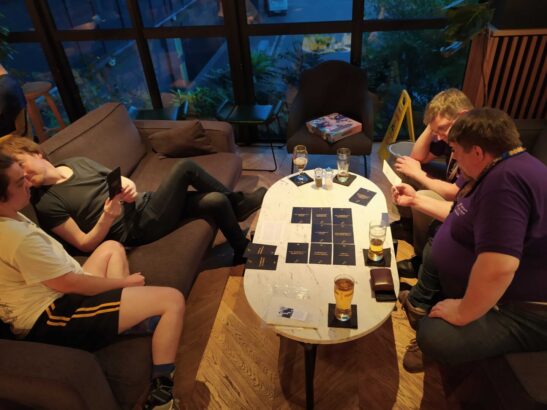
Throughout development, we faced a variety of challenges, but each of them ultimately helped us make the game more enjoyable. Balancing was the main task with every new Case we created, but it was equally important to gather feedback from as many different kinds of players as possible so that we could provide a consistently satisfying experience for future groups.
Hard-to-read witnesses
Originally, players could ask witnesses about any of the 15 pieces of evidence available in that Case. Our intention was to create a real sense of freedom, but players often felt that, despite asking perfectly reasonable questions, they received irrelevant answers from witnesses. With so many possibilities, questioning them could also become quite time-consuming. This led us to a new solution: we removed most of the irrelevant responses, and each witness can now only be questioned about four predetermined pieces of evidence. This also allowed us to balance the witnesses much more effectively, making sure that each one provides an equal amount of relevant information to both teams without that information getting lost among a sea of possible responses.
Cultural differences
The clues and information in the game are closely tied to the world of 1930s America. As players from a wide range of nationalities began testing the prototype, we discovered that certain historical or cultural facts we had taken for granted were not necessarily common knowledge for everyone. As a result, we had to refine the Cases so that nobody would be placed at a disadvantage because they lacked a particular piece of background knowledge, while still preserving the game’s strong historical setting.
Let’s read back the transcript
In an earlier iteration of the game, the Evaluation Sheet worked by checking whether specific words or phrases had literally been mentioned during the Closing Argument. This repeatedly created uncertainty among players. “If the sheet says the phrase ‘dog owner’ needs to be mentioned, does it count if someone says that he owned a German shepherd?” After a few dead ends, we arrived at the idea of Concepts on the Evaluation Sheet. Instead of looking for exact words, these work as broader umbrella categories covering a range of related expressions. If the Concept is “Dog Ownership,” for example, then talking about someone walking their German shepherd or feeding their poodle both count. Based on our playtests, teams have had no trouble using this system. Combined with our recommendation to record the Closing Arguments, we have yet to encounter a situation that two competing teams could not resolve together.
Uncertain Juries
One of the game’s central questions is how coherently and convincingly each team can frame the version of the truth that favors their side. But in courtroom dramas, the outcome does not depend solely on who can present the greatest amount of relevant evidence. It also depends on who can appeal to the human side of the jury. This is how the Uncertain Jury members entered the game. The lawyers have uncovered pieces of information about their backgrounds that reveal what might make them easier to persuade. Rather than having certain details of the Case simply award extra points, we associated them with actual people and small personal stories. This helps players inhabit the situation more fully, reminding them that the court’s decision ultimately depends on the verdict of a group of people with very different personalities.
Awaiting the Verdict
As the game evolved, Villő and Barbi gave it a beautiful visual identity that helped strengthen its atmosphere even further. We tested it with all kinds of people: friends and complete strangers, members of Mindclash’s heavy gamer audience, a narrative video game designer, someone who mostly plays party games, and we even managed to get an actual judge to sit down at the table.
With every playtest, the Cases became more refined. And although the game has not even been released yet, those sessions have already proven something to me: we managed to create a game capable of giving very different kinds of players memorable experiences around the table.
You might think that, as the game’s developers, we could finally sit back and leave the rest to the marketing and sales teams. Fortunately, that is not quite the case; we are already working on new Cases, because we have plans for what comes next.
This time, we will travel to another era with a strong and distinctive atmosphere, where three new Cases will be waiting for us to deliver justice.
For now, Courtroom is available for pre-order: https://preorder.mindclashgames.com/product/courtroom/