May 22, 2026
BoardGameGeek (BGG) Top 100 – Mechanics and Trends at the Peak of the Peak

Robin Hegedűs
Game Designer & Developer
Today, BoardGameGeek is to board gamers what a wise old mountain is to a land: it has always been there, and it feels like it always will be. And yet, someone had to create it. The site was founded in January 2000, at the dawn of the third millennium, by Scott Alden and Derk Solko, with the aim of becoming a “worldwide definitive resource for board games” – a place where everything about board games could be cataloged, and where the community could communicate, share ideas, and build its own creations.
When I describe the site to non-gamers, I usually call it “the IMDb of board games,” which often prompts the question: “So does it also have a top list of the best games ever?” It certainly does! And just like with mountains, people are always curious about who has reached the summit.
In his book The Infinity of Lists, Italian writer Umberto Eco reflects on why humanity loves lists so much. His philosophical conclusion is that, among other things, lists let us confront infinity: they can always be expanded, their rankings can always change, and in a chaotic world they allow us, at least for a moment, to impose order. I always open the BGG Top 100 with excitement myself. Sometimes I hum in satisfied agreement; other times I shake my head in disbelief. But one thing is certain: the list keeps pulling me back again and again – and I know I am not alone.
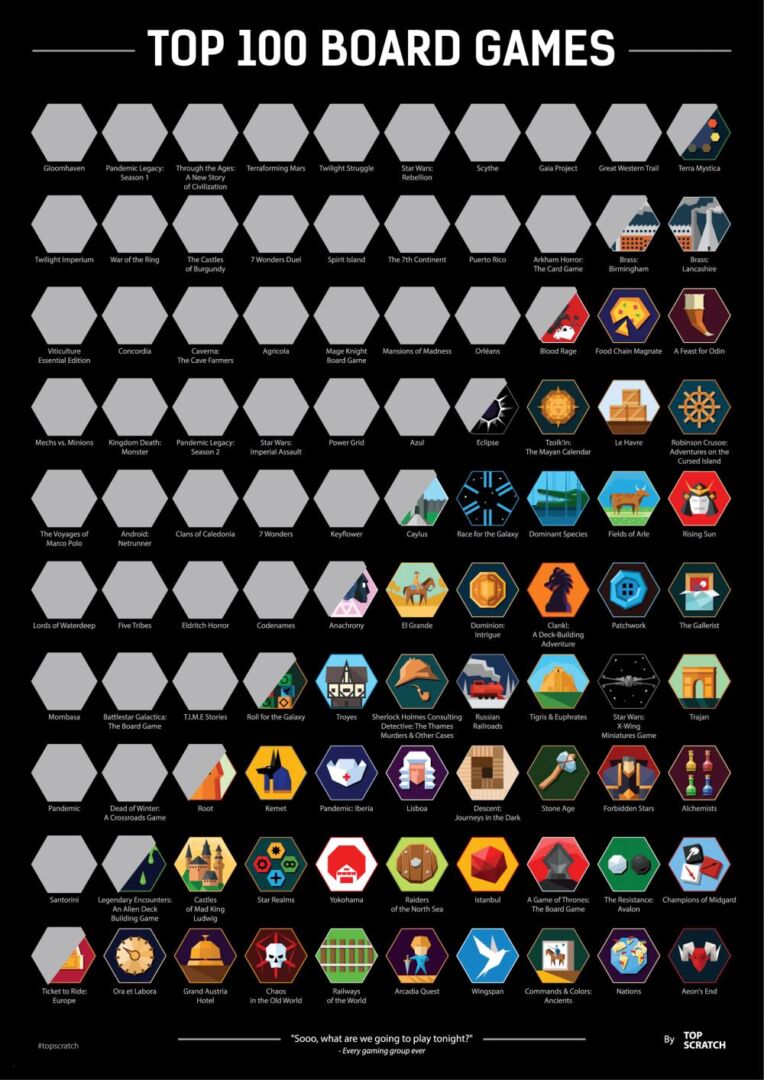
How the BoardGameGeek Top 100 Works
Users rate games, and the game with the highest average rating sits at the top, right? Well, not quite.
BGG’s statistics use a few methods to create a more realistic picture of what people consider the best. First of all, a game needs at least 30 ratings before it can enter the race, preventing creators from simply showering their own game with 10s and instantly sitting on the throne with a 10.0 average – alongside thousands of others.
A similar purpose is served by the method behind the Geek Rating, the number used as the basis for the rankings. This rating includes a few thousand dummy – that is, non-existent – ratings of 5.5. As a result, games with only a small number of ratings start at a disadvantage, and the more real votes they receive, the more they can overcome this artificial barrier.
In other words, to climb the BGG rankings, a game needs not only strong ratings, but also a large voting audience.
Even so, there are games that have both more ratings and a higher average rating than another game, yet still rank below it. On the current list, for example, Gloomhaven performs better than Pandemic Legacy in both respects, yet it stands behind it. BGG does not share every detail of its formula, so that it cannot be gamed too easily, but it is highly likely that votes from profiles that have rated only a small number of games carry less weight.
From the Beginning
The earliest available BGG ranking dates back to September 2002. Even from today’s perspective, it contains fascinating games, many of which are now absolute classics.
- Puerto Rico
- Paths of Glory
- Tigris & Euphrates
- Die Macher
- Princes of Florence
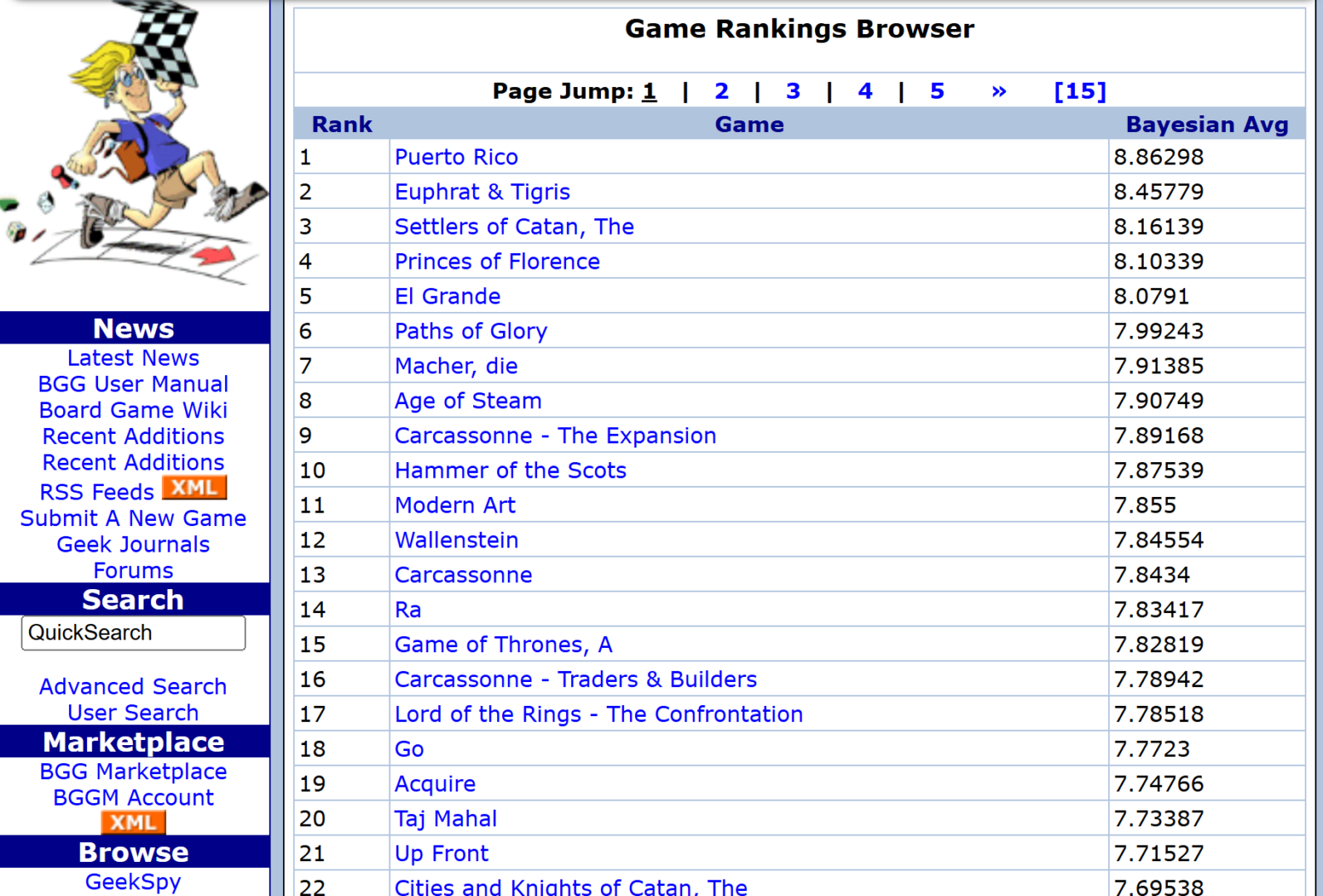
The list also included plenty of Spiel des Jahres winners, evergreen Reiner Knizia titles, and even abstract games such as Go at number 10, Crokinole at number 27, and Tichu at number 29.
Most of us, of course, joined the world of BoardGameGeek later, and we still remember what stood at the top of the ranking back then. From 2002 all the way until 2008, the classic economic role-selection game Puerto Rico was the king of games. I myself discovered the website sometime toward the end of that reign.
Until 2010, the top spot was held by Agricola, the finest worker-placement farming simulator. Then, until 2015, came the Cold War card-driven masterpiece Twilight Struggle (cue a nostalgic tear). Until 2017, the number-one game was the cooperative legacy game about fighting global outbreaks, Pandemic Legacy. It was followed by Gloomhaven, which held the throne until 2023. Since then, the top position has belonged to Brass: Birmingham, the reimagining of Martin Wallace’s classic, and it still holds that spot today – though Ark Nova is already knocking loudly at the gates.
The Current List and the Trends That Shape It
The games on the Top 100 – however much debate they may inspire, as we will discuss later – always give a clear sense of what kinds of games are currently moving the gamer community. The present list therefore offers a useful cross-section of the types of games that occupy the minds of hobbyists today.
Although the boundary between “Euro” and “Ameri” games is becoming increasingly blurred, the Top 100 still shows that 49% of the games can be classified as Euro-style games. Games that could be described as hybrids make up 21%, while Ameri-style games account for 20%. The remaining 10% are mostly abstract or party games.
In terms of mechanics, the strong presence of Euro games already suggests that economic games, engine-building games, and worker-placement games form one of the most significant genres, accounting for 34% of the list. Another 21% of the games aim to provide a shared narrative experience: cooperative, thematic campaign games make up roughly one fifth of the Top 100. Card-driven games also occupy a considerable share, with deck-building, tableau-building, and LCG-style games making up 17%.
The gaming community is often accused of being driven by the “cult of the new,” so it is worth looking at when the games on the list were published. Of the Top 100, 56% appeared in the 2010s, while 36% have already been released in the 2020s. Only 8% of the list was published before 2010. In other words, the backbone of the list comes from the middle and later stages of the modern board game renaissance. Games released between 2015 and 2024 make up 80% of the list. This shows that the BGG Top 100 strongly favors modern, complex titles that are widely played and widely rated.
As for Mindclash Games, Anachrony reached its highest position on this list in 2022, when it stood at number 44. At the time of writing, it is ranked 61st. Meanwhile, Voidfall is climbing the ladder and currently stands at number 84.

Criticism of the Ranking
One of the most important criticisms of the Top 100 is precisely the point mentioned above: the high representation of newer games. Some argue that new games receive higher ratings because they feel fresh, and because players have recently spent money on them – especially when we are talking about a deluxe Kickstarter edition. A similar argument is often made about story-driven campaign games. As with TV series, if you have played only part of the experience, you may hesitate to rate it because you have not yet seen the whole thing. But in reality, you are only likely to play through an entire campaign if you enjoy the gameplay, which means you will probably give it a high rating at the end.
Others argue that newer designs are simply better. Game designers and publishers have learned a great deal over the decades, and today’s games tend to be more thoroughly developed and polished.
Another major criticism is that many people do not use their ratings to reflect their own play experience, but instead treat them as a kind of protest signal. Games can be rated even before they are released, and later on, too, many votes are cast not as evaluations of gameplay but as statements of opinion. Do you dislike how a publisher operates? Is there too much hype around an upcoming game? Do you simply hate the cover art? Boom – a big red 1. Do you love the publisher? Do you think a game deserves more recognition? Are you just rooting for it to overtake a game you dislike? Bam – a big green 10.
Complex games are also far more present in the rankings than lighter titles that may be enjoyed by many people. This highlights just how difficult it is to objectively compare the experiences offered by two games such as Through the Ages and Decrypto – both of which are brilliant.
Among complex games, the ones most likely to rise to the top are those that many people love, but that few people feel compelled to rate poorly. In other words, when a game reaches a broader and more mixed audience, it also receives more critical ratings. As a result, a game aimed at a narrower target audience, but adored within that audience, can rank higher than a more widely played yet more divisive title.
Ultimately, the BGG Top 100 is not an objective canon carved into stone, but a living snapshot of the hobby: its fashions, passions, blind spots, and shared obsessions. It rewards depth, ambition, momentum, and community enthusiasm — sometimes fairly, sometimes controversially. But perhaps that is exactly why we keep returning to it. Whether we agree with the rankings or argue with them, the list gives us a common peak to point at, debate, climb, and occasionally – as a designer or publisher – try to conquer ourselves.